
Hello, creators! 🎥🤖
If you’ve been experimenting with AI-generated video, you know one of the biggest limitations has been camera control — or rather, the lack of it. Most AI video models generate random, often unpredictable movements, making it tough to get that polished, cinematic feel.
That’s where Hailuo AI’s T2V-01 Director Mode comes in. This new update gives users direct control over AI-generated camera movements, allowing for more precise, professional-looking shots. Think push-ins, tracking shots, and smooth transitions — all from simple text commands.
If you’ve ever wished AI video tools had more director-level controls, this might be the update you’ve been waiting for.
What is T2V-01 Director Mode?
T2V-01 Director Mode is an AI-powered video generation tool by Hailuo AI (MiniMax) that allows users to:
- Control camera movement with natural language commands.
- Combine multiple motions for smoother, cinematic shots.
- Reduce randomness for more predictable and professional results.
- Fine-tune movement speed and accuracy to match creative intent.
Rather than letting AI decide how the camera moves, you now get to direct it—just like a filmmaker.
How It Works: Directing AI Like a Pro
With T2V-01 Director Mode, you structure your text prompts using four key elements:
- Main Subject — What’s in the first frame?
- Motion/Change — What action happens next?
- Camera Movement — How should the camera move?
- Aesthetic Atmosphere — The style, lighting, and mood.
For example, if you wanted a Hitchcock-style suspense shot, your prompt might look like this:
📝 [Push in] Close-up of a tense woman looking to the left, startled by a sound in a dimly lit 1950s-style kitchen. [Shake] As her fear grows, the camera trembles slightly, enhancing the suspense.
These bracketed camera commands—like [Push in] or [Shake]—are the magic behind Director Mode.
Key Features of T2V-01 Director Mode
1. Smooth, Cinematic Camera Transitions
One of the biggest upgrades is the ability to combine different camera moves in a single shot, such as:
🎥 Push-in to tracking shot — Gradually zooming in before following a moving subject.
🎥 Over-the-shoulder to wide shot — Enhancing dialogue scenes for dramatic effect.
🎥 Dolly zooms and shakes — Perfect for action or horror sequences.
2. Reduced Randomness for More Control
In previous AI video models, camera movement often felt random or inconsistent. This update ensures:
✔️ More predictable results with structured movement.
✔️ Better consistency across multiple generations.
✔️ More refined aesthetics, reducing unnatural shifts.
3. Professional-Grade Camera Aesthetics
With enhanced control accuracy, users can replicate real-world cinematography techniques — from handheld shakiness to steady tracking shots. This makes AI video generation feel less experimental and more production-ready.
How T2V-01 Director Mode Compares to Other AI Video Tools
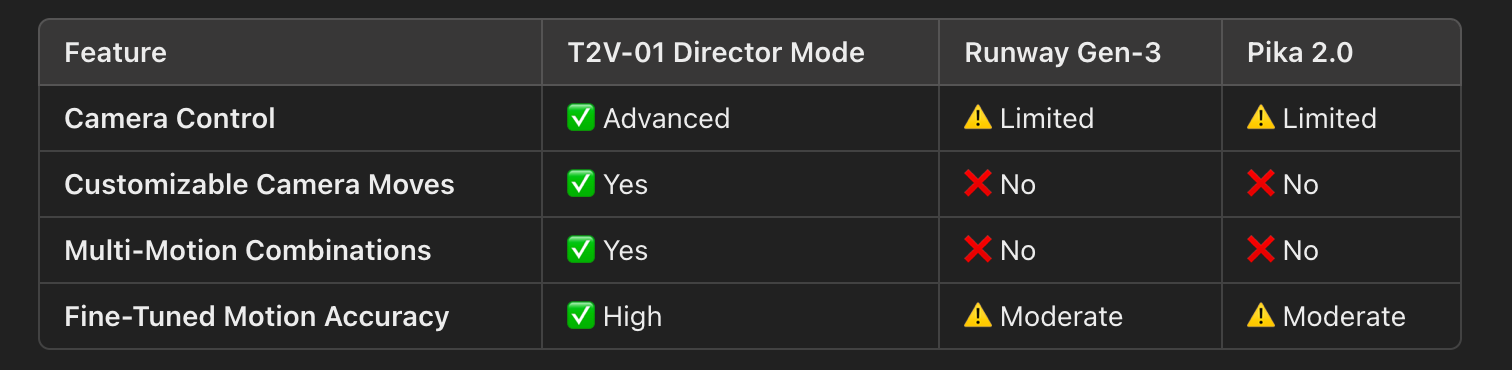
If you’ve used tools like Runway or Pika, you know they can generate beautiful AI videos — but they often lack the precise control over movement that filmmakers need. T2V-01 Director Mode bridges that gap, making AI video more practical for professional use.
Why This Matters for AI Video Creation
With this update, Hailuo AI is pushing AI video toward a future where creators can truly direct AI-generated content. Here’s why it’s exciting:
- More Creative Freedom — AI-generated video is no longer a guessing game — you can plan shots like a real director.
- Better Storytelling — Camera movement is a crucial part of visual storytelling, and now AI can replicate professional cinematography.
- AI Video Moves Closer to Hollywood-Level Production — This update makes AI-generated video far more polished and usable in real-world projects.
Final Thoughts: Is This the Future of AI Video?
With T2V-01 Director Mode, AI video generation is finally stepping into true cinematic territory. No more random, chaotic camera movement — now, you can direct shots like a pro and get the results you actually want.
If you’ve ever felt frustrated by the limitations of AI video tools, this update might change the way you see AI filmmaking.
Would you trust AI to direct a short film? Let’s discuss.


 KINOMOTO.MAG